
At the AEE conference in Estes Park, Michelle Cummings from Training Wheels and Personify Leadership was running a session on ‘Experiential Team Building for Corporate Groups: Activities that Engage and Deliver Results’.
She kicked off with a distinction that really gets to the heart of what most groups are looking for. Team building is all about having a good time. It may follow a schedule; it doesn’t necessarily require any reflection and can indeed stand on its own.
Team building centers on a specific goal that is transferable to the workplace or school, has a structured curriculum or flow, is facilitated by people skilled in experiential techniques, includes built-in reflection, and may have a follow-up.
Team development is a longer-term exercise that involves behavioral assessments, ongoing coaching, and outcomes in behavioral and organizational change. The session was in the middle category.
Participants went through several activities. One involved using generation cards, where each person answered a question related to their generation. Another was Common Bond: find a partner, locate the shared image on the card, then find one rather obvious thing in common. There was a variation called Blind Find, where you had to memorize the card first.
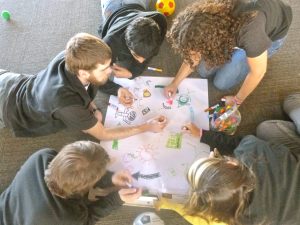
The main activity was strings. People gathered around a central point, each person taking one end of a string, holding it in their hand, and creating a tangle. The groups then swapped and went round to untangle the mess another group had created, with the facilitator timing them.
Debrief points were the pre-stories people brought to the activity, whether or not they held back even when they were allowed to act with conviction, the difference between a micromanaged group (where everyone was constantly being told what to do) and a group that just went about it with less talking and more synchronicity, and the experience of having to clean up someone else’s mess.
Cummings framed the processing questions as what happened, why, so what, and what was the intent. She noted that teams can use those same questions on their own.
She made it very clear that most people hate team building because you don’t explain the ‘why’ behind it. Connection comes before content. The activities should be designed to reveal real team behaviors (communication, trust, collaboration, etc.) rather than be a surface-level exercise.
The difference between bonding, building, and development aligns with the experiential learning literature, which sees transfer as a function of intentional design rather than simply activity. Kolb’s cycle is clearly evident in the progression from the string activity through to the immediate discussion of the pre-stories and leadership style.
Psychological safety work underpins the session’s attention to whether or not people felt they had permission to act or were, in fact, holding back. None of the sources actually prescribe a single sequence. They do, however, support the contention that brief, structured activities followed by focused reflection will reveal work-related behaviors if the facilitator is clear about the purpose.
For anyone facilitating groups that have to make decisions under real-world constraints, the practical takeaway is the same. Activities that don’t take account of the constraints produce notes that don’t transfer. Activities that do take account of the constraints produce notes that do.
Refereneces
Cheng, J., Wu, Y., Huang, L., Wu, Y., & Guan, Y. (2025). Integrating Kolb’s experiential learning theory into nursing education: a four-stage intervention with case analysis, mind maps, reflective journals, and peer simulations for advanced health assessment. Frontiers in Medicine, 12, 1616392.
O’Carroll, C., & Scanlon, D. (2026). An outdoor educator’s self-study of enacting a pedagogical model for outdoor adventure education to facilitate affective learning experiences. Physical Education and Sport Pedagogy, 31(1), 81-96.